FORTIFIED works. So does wildfire resilience. These are real storms, real fires, real communities, and real outcomes. Some of these are SHA projects. Others are examples of resilient construction performing as intended nationwide. All of them make the case for building stronger before the next disaster.
Hurricane Sally, 2020, Coastal Alabama
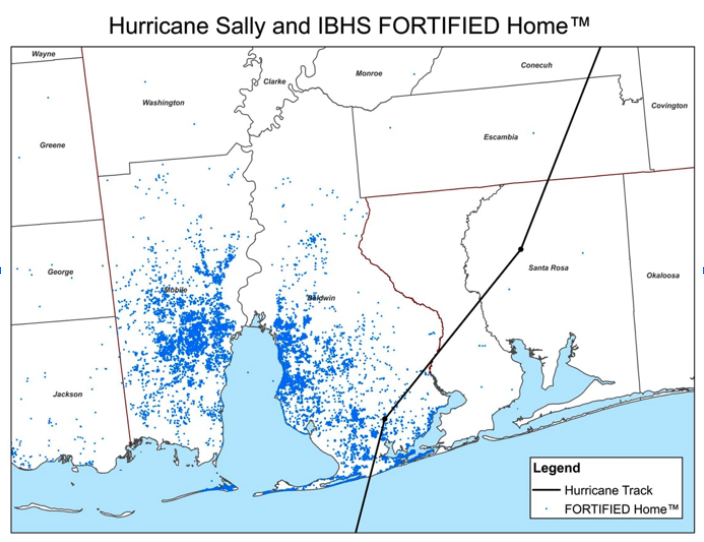
Hurricane Sally made landfall at Gulf Shores on September 16, 2020, as a strong Category 2 storm with sustained winds of 105 mph. It was the first hurricane to strike a large concentration of FORTIFIED homes anywhere in the country.
Of the 17,000+ FORTIFIED homes and 19 FORTIFIED Commercial structures in coastal Alabama, over 95% saw little to no damage.
In 2025, a peer-reviewed study by the University of Alabama's Center for Risk and Insurance Research confirmed what was observed on the ground. Analyzing over 40,000 insured properties, the study found that FORTIFIED Roof homes had 73% fewer claims and 72% lower total losses than conventional construction. FORTIFIED Gold homes performed even better. Insurers would have saved over $105 million in losses if all homes in the storm's path had been built to the FORTIFIED Roof standard.
Fairhope, AL, Code Supplement in Action
Fairhope adopted and enforced the Coastal Construction Code Supplement before Sally hit. The results showed up in their post-storm debris numbers. Construction and demolition debris, the kind generated when structures fail, made up just 3% of total debris collected after the storm. Total cleanup cost $8.1 million. C&D cleanup was just $243,000 of that. When buildings survive, communities spend less on cleaning up what's left of them.
Hurricane Ida, 2021, Lockport, Louisiana
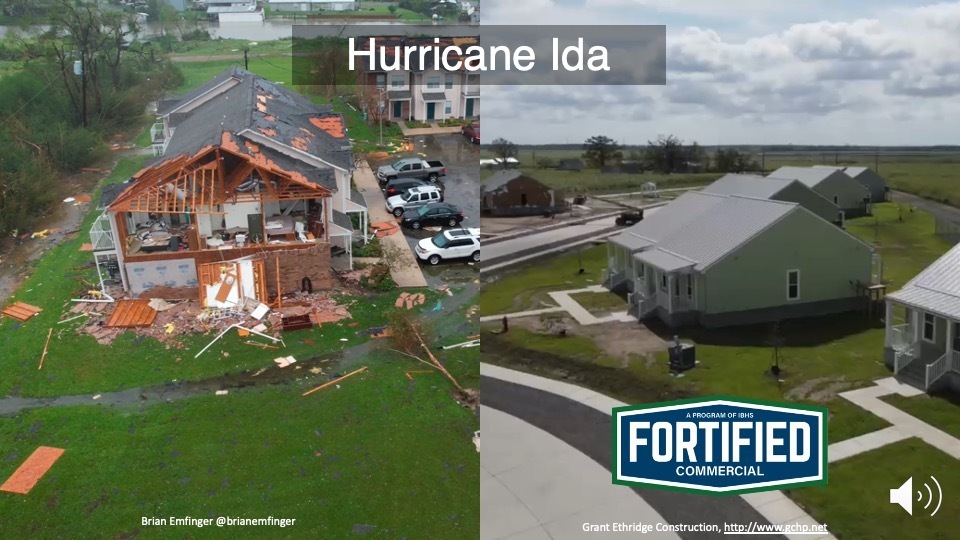
Category 4 Hurricane Ida's eye passed directly over Lockport, Louisiana. Two apartment complexes sat half a mile apart. One was built to the FORTIFIED Commercial standard. The difference in damage was visible immediately. The FORTIFIED buildings had not yet opened when Ida hit. It reopened just three weeks later. Families displaced from the destroyed complex moved in.
SHA supported the expansion of FORTIFIED Multifamily and Commercial construction in Louisiana in the years leading up to Ida, providing technical assistance to developers and housing agencies pursuing designation.
EF-3 Tornado, January 2023, Prattville, Alabama
A supercell produced tornadoes across Mississippi, Alabama, and Georgia, damaging approximately 16,800 properties with a combined reconstruction value of nearly $4.5 billion. In Prattville, AL, a homeowner had received a FORTIFIED Roof through Habitat for Humanity of Autauga and Chilton Counties via the Strengthen Alabama Homes grant program. The home was in the path of the EF-3. It sustained shingle loss and a damaged soffit. That was it.
Los Angeles County Fires, 2025, Altadena and Pacific Palisades
The Palisades and Eaton Fires were California's second and third most destructive wildfires on record, destroying over 16,000 structures. SHA has been engaged in California's wildfire resilience and insurance conversations for years, including Julie Shiyou-Woodard's keynote at the After the Fire Wildfire Leadership Summit, testimony at a California Department of Insurance workshop on catastrophe modeling, and expert commentary in national coverage of California's first state-mandated wildfire insurance discount program.
The fires confirmed what the science already showed. Homes with a full system of hardening features were 54% less likely to sustain damage. Homes with significant vegetation within five feet faced nearly 90% risk of damage or destruction. IBHS research shows building back to the Wildfire Prepared Home standard adds just 3% to key construction costs. SHA continues to provide education and technical assistance in the wildfire resilience space, applying the same policy and market development approach it built on the Gulf Coast.